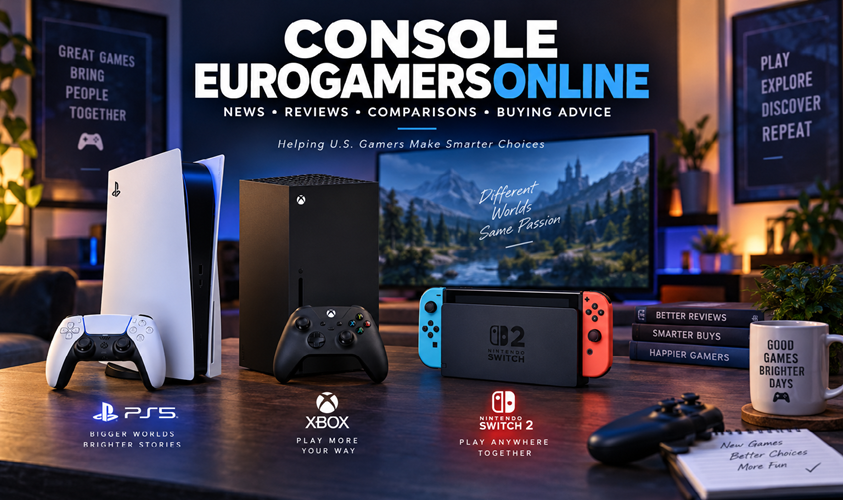
Console Eurogamersonline
If you’ve searched for console eurogamersonline, you’re likely looking for console gaming coverage associated with Eurogamer.
The phrase itself is unusual. It doesn’t describe a major console brand or a standalone gaming platform. Instead, it appears to combine a console-related search with the name of a well-known gaming publication.
That distinction matters.
Gamers searching for this topic are usually looking for useful information: console news, hardware reviews, game recommendations, performance analysis, and buying advice.
For U.S. players, that information can make a real difference. Choosing a console isn’t simply a matter of picking the machine with the best specifications. Your decision affects the games you can play, the accessories you’ll need, your online services, storage requirements, and the total amount you’ll spend over several years.
This guide breaks down what console eurogamersonline means, how to evaluate console coverage, and what American gamers should consider before buying a PlayStation, Xbox, or Nintendo system.
What Does Console Eurogamersonline Mean?
Console eurogamersonline is best understood as a search phrase related to Eurogamer’s online console gaming coverage.
It doesn’t appear to identify a separate gaming company, console, or hardware product. Someone using the phrase may simply be trying to find Eurogamer’s coverage of console games and hardware.
That coverage can include:
- PlayStation news and reviews
- Xbox coverage
- Nintendo hardware and games
- Console comparisons
- Game reviews
- Hardware analysis
- New-release coverage
- Gaming features
- Industry news
- Buying advice
The distinction is useful for both readers and publishers. A page targeting this keyword should provide genuine console information instead of treating “Eurogamersonline” as though it were a hardware product.
Also Reed: EuroGamersOnline the Different Types
Why Console Gaming Coverage Still Matters
Console specifications tell only part of the story.
A manufacturer can tell you how much storage a system has, how powerful its processor is, or what resolution it supports. Those numbers are useful, but they don’t explain what using the console actually feels like.
That’s where independent gaming coverage has value.
A good review looks at everyday performance. It considers loading times, controller design, game libraries, system software, graphics modes, noise, storage, and long-term value.
The same principle applies when comparing consoles.
Two systems may have similar capabilities on paper but offer very different experiences. One might have the games you care about most. Another could offer better subscription value. A third may make more sense for families or players who want portable gaming.
For that reason, experienced console journalism focuses on the complete ownership experience rather than a specification sheet alone.
The Major Console Platforms
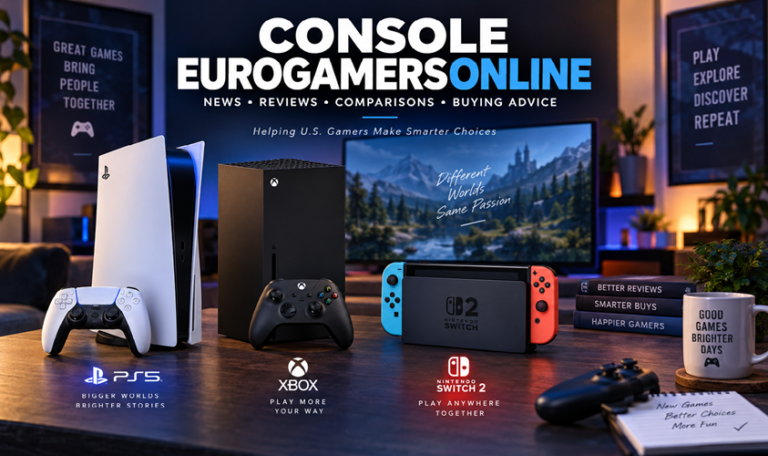
PlayStation 5
The PlayStation 5 remains one of the leading home gaming platforms in the United States.
Sony offers several PS5 configurations, including the standard console, the PS5 Digital Edition, and the higher-performance PS5 Pro.
The biggest distinction is simple: physical-media support, price, and performance vary by model.
The standard PS5 gives players access to physical and digital games, while the Digital Edition focuses on downloads. The PS5 Pro targets players willing to pay more for enhanced graphics and performance in supported games.
Sony’s official PS5 information also highlights backward compatibility with a large library of PS4 games.
Pricing deserves special attention in 2026. Sony announced U.S. price changes for its PS5 lineup in March 2026, raising the recommended prices of several models.
That is a good reminder for buyers: don’t rely on an old console buying guide when making a purchase. Check current pricing first.
For players who care about major first-party releases, visual quality, and a large established game library, PS5 remains a strong option.
Xbox Series X and Series S
Microsoft takes a different approach with the Xbox Series family.
The Xbox Series X is the company’s higher-performance console. The Series S is smaller, less powerful, and designed around digital gaming.
That difference makes the Series S particularly interesting for budget-conscious players.
Microsoft positions the Series S as an all-digital console. Depending on the configuration, it offers either 512GB or 1TB of storage and targets gaming at up to 1440p, with support for higher frame rates in compatible titles.
The Series X is aimed at players who want more graphical performance and physical-game support on compatible hardware.
But Xbox isn’t only about hardware.
Microsoft’s broader ecosystem, including its subscription services and cross-device approach, can be just as important to a buyer’s decision.
For some players, the better question isn’t “Which Xbox is more powerful?”
It’s “Which Xbox setup gives me the games and services I actually want?”
Nintendo Switch 2 Changed the Console Conversation
Nintendo launched the system on June 5, 2025, positioning it as the successor to the original Switch while retaining the hybrid concept that made that system so distinctive.
The hardware brings a larger 7.9-inch display, 1080p handheld output, up to 4K output when connected to a compatible display, improved processing power, and redesigned Joy-Con 2 controllers.
Nintendo also added GameChat, which supports voice communication and screen sharing. Compatible camera hardware enables video features.
The system launched in the U.S. at $449.99, while the Mario Kart World bundle launched at $499.99.
Its early sales were striking. Nintendo reported more than 3.5 million Switch 2 systems sold worldwide during the first four days after launch, making it the company’s fastest-selling game system at the time.
For American gamers, the appeal is straightforward: Switch 2 can serve as both a home console and a portable gaming system.
That’s something neither PlayStation nor Xbox offers in quite the same way.
Console Comparison: Which Platform Fits You?
| Platform | Best For | Key Strength | Main Consideration |
|---|---|---|---|
| PS5 | AAA and cinematic games | Strong game library and first-party titles | Hardware cost |
| PS5 Digital Edition | Digital-only players | Simple download-focused setup | Physical games require a disc solution |
| PS5 Pro | Enthusiasts | Enhanced graphics and performance | Premium price |
| Xbox Series X | Performance-focused gamers | Powerful hardware and Xbox ecosystem | Larger physical footprint |
| Xbox Series S | Budget-conscious players | Compact and affordable approach | Lower performance |
| Nintendo Switch 2 | Families and portable gamers | Hybrid design | Different game ecosystem |
There isn’t one universally superior console.
Your priorities should determine the winner.
Someone who plays competitive shooters may care about frame rates and display performance. A family might prioritize local multiplayer. A collector may want physical games. Someone who travels frequently could value Nintendo’s portable format above raw graphical power.
The best console is the one that fits your actual habits.
What to Look for in Console Reviews
A useful console review should answer questions that a manufacturer’s specification sheet cannot.
Performance
Don’t get distracted by marketing terminology.
Look for real-world information about:
- Resolution
- Frame-rate performance
- Loading times
- Graphics quality
- Ray tracing
- Performance stability
- Storage speed
- Fan noise and thermals
A specification tells you what hardware can potentially do. Gameplay testing tells you how consistently it does it.
Game Library
This is arguably the most important factor.
Before buying a console, look at the games you genuinely want to play.
Make a short list of five or ten titles.
Then ask which platform gives you the strongest access to those games.
A console with impressive hardware is a poor investment if it doesn’t have the games you want.
Online Services
Online gaming is now a central part of the console experience.
Subscription services may provide online multiplayer, game catalogs, discounts, cloud-related features, or other benefits.
But these services change over time.
Games can be added and removed. Prices can change. Features can evolve.
Always check the current terms before treating a subscription as part of a console’s long-term value.
Storage
Modern games can take up a surprising amount of space.
A handful of large installations can quickly consume internal storage.
Before buying, check:
- Available internal storage
- Expansion options
- Compatible storage formats
- Expansion costs
- Whether games require additional downloads
A cheaper console can become more expensive if you immediately need additional storage.
Physical Games vs. Digital Games
The physical-versus-digital debate hasn’t disappeared.
Both formats have legitimate advantages.
Physical Games
Pros
- Games can often be resold
- Used copies may cost less
- Collectors can build physical libraries
- Physical games can make convenient gifts
- Retail discounts can sometimes beat digital pricing
Cons
- Discs and cartridges require storage
- Physical media can be damaged
- Many games still require substantial downloads
- Disc-based games can still consume internal storage
Digital Games
Pros
- Immediate downloads
- No physical media to manage
- Easy access from your account
- No disc swapping
- Convenient for frequent players
Cons
- Large downloads can take time
- Storage fills quickly
- Digital licenses aren’t as flexible as physical copies
- Digital prices aren’t always lower
For U.S. buyers, the right choice often comes down to buying habits.
If you regularly trade, sell, or purchase used games, physical media still has a strong case. If convenience matters most, digital libraries are hard to beat.
How Eurogamer-Style Reviews Help Buyers
The strongest gaming reviews don’t simply answer whether a product is “good.”
They explain who should buy it and why.
For example:
- Is the upgrade noticeable on a typical TV?
- Does the controller genuinely improve gameplay?
- Are performance modes stable?
- Does the console offer enough storage?
- Is the price justified?
- Does the system make sense for someone who already owns the previous generation?
Those questions turn technical information into useful buying advice.
That’s one of the biggest differences between a specification page and professional gaming journalism.
Pros and Cons of Following Console Gaming Coverage
Pros
- Helps track new hardware
- Makes console comparisons easier
- Provides independent game reviews
- Highlights important releases
- Explains technical differences
- Can prevent expensive buying mistakes
- Adds context that manufacturer marketing doesn’t provide
Cons
- Reviews naturally reflect the reviewer’s preferences
- Prices can change after publication
- Game availability varies by region
- Subscription catalogs can change
- Early impressions don’t always reveal long-term reliability
- Older buying guides can become outdated
The best approach is to use independent reviews for analysis and official manufacturer pages for current specifications, pricing, and compatibility information.
Expert Tips for Choosing a Console in 2026
1. Start With the Games
Don’t begin with teraflops, resolution, or marketing features.
Start with the games.
Write down the five titles you most want to play. Then see which platform gives you the best access to them.
That simple exercise can eliminate much of the confusion.
2. Calculate the Real Cost
The console price is only the starting point.
Your actual budget may include:
- Games
- Online subscriptions
- Extra storage
- Additional controllers
- Headsets
- Charging accessories
- Cases
- Display upgrades
Consider the total cost of ownership rather than the sticker price.
3. Match the Console to Your TV
A premium console makes more sense when your display can take advantage of its capabilities.
If you’re using an older 1080p television, some benefits of a high-end upgrade may be difficult to appreciate.
You don’t necessarily need the most expensive console to have a great gaming experience.
4. Consider Your Internet Connection
Digital gaming depends heavily on download speeds.
Large modern releases can take significant time to install.
If your connection is slow or subject to data caps, physical games may be more appealing.
5. Don’t Buy Based on Specifications Alone
More powerful hardware doesn’t automatically mean a better experience.
Controller comfort matters. Game selection matters. System software matters. Online services matter.
So does whether you’ll actually use the hardware’s extra performance.
6. Check Current Prices
Console pricing isn’t permanent.
Sony’s 2026 PS5 price changes are a good example of how quickly an older buying guide can become inaccurate.
Before purchasing, verify the current price on the manufacturer’s website and compare it with reputable retailers.
(FAQs) About Console Eurogamersonline
1. What does console eurogamersonline mean?
Console eurogamersonline appears to be a search phrase connecting console gaming with Eurogamer’s online coverage. It doesn’t identify a major standalone console or gaming platform.
2. Does Eurogamer cover PlayStation consoles?
Yes. Eurogamer has extensive coverage of PlayStation hardware, games, reviews, features, and industry developments.
3. Does Eurogamer cover Xbox?
Yes. Xbox hardware, games, services, and releases fall within the publication’s broader console coverage.
4. Does Eurogamer cover Nintendo Switch 2?
Yes. Nintendo Switch 2 is now a major part of the current console market. Nintendo launched the system on June 5, 2025.
5. Is PS5 still worth buying in 2026?
For many players, yes. PS5 has an established game library and several hardware options. The right choice depends on your preferred games, budget, display, and whether you want physical or digital games.
6. Is Xbox Series S good for casual gaming?
It can be a sensible choice for players who want a smaller, digital-focused console and don’t need the performance of the Series X.
Its lower hardware performance is the main trade-off.
7. Is Nintendo Switch 2 more powerful than the original Switch?
Yes. Nintendo describes Switch 2 as a more powerful successor with upgraded processing capabilities and improved graphics performance.
8. Should I buy physical or digital games?
Physical games make more sense if you value resale, collecting, or used-game shopping. Digital games offer convenience and quick access.
Neither format is universally better.
9. Which console is best for families?
Nintendo Switch 2 is particularly appealing for families because of its hybrid design and emphasis on local and shared play.
However, the best option ultimately depends on the games your household prefers.
10. Where should I check console specifications?
Use official manufacturer websites for current specifications, pricing, compatibility, and product information.
Independent gaming publications are most useful for reviews, comparisons, and real-world performance analysis.
Conclusion: Console Eurogamersonline
The phrase console eurogamersonline is better understood as a search query around Eurogamer-related console coverage than as the name of a particular product.
For readers, the bigger question is what they actually need from console gaming coverage.
A good resource should help you understand hardware, compare platforms, evaluate games, and make smarter buying decisions.
The major choices remain distinct. PS5 offers a mature ecosystem and a strong catalog of major releases. Xbox Series X and Series S provide different performance and pricing options within Microsoft’s wider gaming ecosystem. Nintendo Switch 2 takes the hybrid approach further with more powerful hardware, new social features, and the ability to move between handheld and TV gaming. Nintendo launched the system at $449.99 in the U.S., while its Mario Kart World bundle launched at $499.99.
The right choice isn’t necessarily the console with the strongest specification sheet.
It’s the one that fits your games, your display, your budget, and the way you actually play.
About the Author