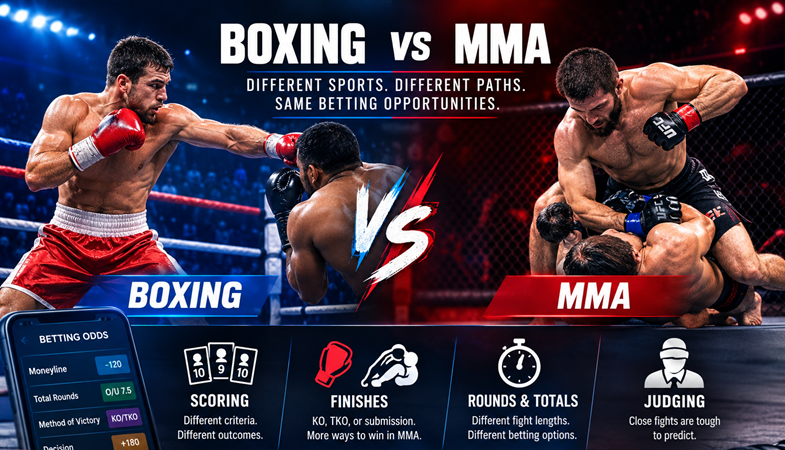
Boxing and mixed martial arts (MMA) share plenty of betting options, including moneylines, round totals, and method-of-victory bets. The differences become clearer when you look at how judges score a fight, what counts as a finish, and how long competitors have to get the job done.
A boxer might spend several rounds landing clean punches before a late knockout changes everything. An MMA fighter can threaten a finish with punches, kicks, takedowns, or a submission on the ground. Those different paths to victory shape the markets available to fans who follow both sports.
How scoring changes the betting picture
Professional boxing generally uses the 10-point must system, with three judges scoring each round. The winner usually receives 10 points, while the opponent gets nine or fewer. Clean punching, effective aggression, ring generalship, and defense guide the scoring. A knockdown can swing a round significantly, especially when the fighters were otherwise evenly matched. The Association of Boxing Commissions details these standards in its unified boxing rules.
MMA also uses the 10-point must system under the Unified Rules, although judges evaluate effective striking and grappling alongside the impact of takedowns and submission attempts. A fighter who lands fewer punches can still win a round through effective ground attacks or dangerous submission attempts. Total strike counts alone rarely tell the whole story.
A technically skilled boxer might win on points through consistent, accurate combinations, while an MMA fighter could build a lead through effective grappling. When both competitors are durable and difficult to finish, a decision becomes a more relevant possibility to consider.
Fans exploring the types of boxing can compare boxing’s scoring priorities with MMA’s broader range of techniques. These differences matter when comparing moneyline and decision odds.
Knockouts, submissions, and other finishes
Boxing revolves around knockouts (KOs), technical knockouts (TKOs), and decisions. A KO generally occurs when a fighter cannot beat the referee’s count after a knockdown. A TKO happens when the referee stops the contest for safety, or when the corner or ringside doctor intervenes under the applicable rules. Sportsbooks may combine KOs and TKOs into one selection or offer separate options.
MMA adds submissions to the available outcomes. A rear-naked choke, armbar, or guillotine choke can end a fight when an opponent taps or the referee steps in. That gives method-of-victory markets another dimension, particularly when a skilled grappler faces a striker with weaknesses in takedown defense.
When comparing finish markets, look at the techniques each fighter regularly uses and the weaknesses their opponent has shown. A few useful factors include:
- A boxer with heavy hands and a strong record of stoppage wins may attract attention in the knockout market.
- An MMA fighter with a dangerous ground game may offer a different finishing threat through submissions.
- A competitor known for endurance and defensive skills may be more likely to take a fight into the later rounds.
- Recent finishes can reveal patterns, although the quality of the opposition matters just as much as the result.
These factors can help narrow down the likely finishing methods, especially when a fighter’s strengths line up with an opponent’s defensive weaknesses.
Round betting and fight totals
Scheduled fight length shapes round betting and over/under markets. Professional boxing bouts can run for four, six, eight, or ten rounds, while championship contests commonly last 12. Most UFC non-title bouts have three five-minute rounds, while championship fights generally have five. Always check the scheduled distance because individual events and promotions can have different formats.
Consider a 10-round boxing match with an over/under line of 7.5 rounds. The bet depends on whether the fight passes the specified threshold. In a three-round MMA bout, a 1.5-round total offers a similar choice over a shorter distance. A fighter’s pace, conditioning, defensive ability, and finishing record can all help you assess how long the contest might last.
Before betting on totals or exact rounds, check the sportsbook’s settlement rules. These can specify how much of a round must elapse for an over bet to win and how technical decisions, disqualifications, or accidental fouls affect the result. Other details worth checking include:
- Whether a stoppage at a particular timestamp counts toward the over or under.
- Whether the market covers the full scheduled fight or a specific round.
- How the bookmaker settles a fight that ends through disqualification or a technical decision.
- Whether a draw or no contest changes the settlement of the selected market.
Checking these details before placing a bet helps you understand exactly which outcomes qualify as a win and how the sportsbook handles unusual fight endings.
Why judging makes close fights difficult to predict
Boxing judges assess clean punches, effective aggression, ring generalship, and defense. A fighter who throws more punches can lose a round if the opponent lands cleaner, more effective shots. Knockdowns and point deductions can also change the score, making a close contest difficult to call from ringside impressions alone.
MMA presents a different judging challenge. One fighter might lead in total strikes, while the opponent lands more damaging blows or creates meaningful submission threats. Takedowns and control time provide context, but judges focus on effective striking and grappling when applying the Unified Rules. The quality of the action matters more than control time alone.
When assessing decision markets, keep several details in mind:
- A boxer who consistently lands clean combinations may win rounds even without scoring a knockdown.
- An MMA fighter who inflicts more damage or creates dangerous submission opportunities can win rounds despite trailing in total strikes.
- Point deductions, knockdowns, and dominant rounds can have a major effect on the final scorecards.
- Close fights carry additional uncertainty because judges can interpret individual rounds differently.
These factors are worth considering when assessing decision markets, since a fighter’s overall performance and the judges’ interpretation of individual rounds both influence the final result.
The matchup often matters more than the sport’s reputation. Two defensive boxers may be more likely to produce a points decision, while an MMA contest between an aggressive wrestler and a dangerous submission specialist could offer several plausible finishing scenarios. Style, conditioning, and defensive weaknesses help explain those possibilities, although every fight remains unpredictable.
About the Author