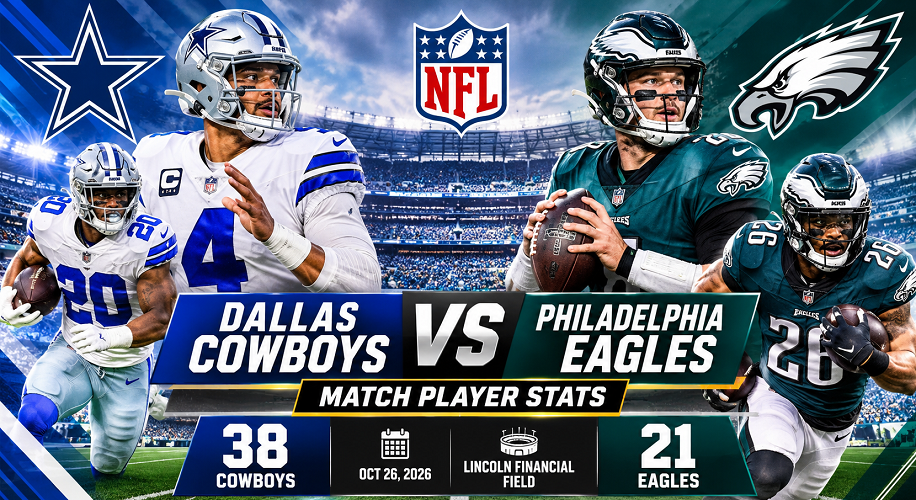
Dallas Cowboys vs Philadelphia Eagles Player Stats
Few NFL rivalries generate the excitement of a Dallas Cowboys versus Philadelphia Eagles matchup. These NFC East opponents bring history, intensity, and plenty of competitive football whenever they meet. Dallas Cowboys vs Philadelphia Eagles Player Stats. Their October 26, 2026, meeting at Lincoln Financial Field added another memorable chapter to the rivalry. Dallas defeated Philadelphia 38–21, delivering a convincing performance on the road.
The Cowboys found success through a balanced offence. Dak Prescott connected on three touchdown passes, Javonte Williams powered the rushing attack, and CeeDee Lamb delivered two receiving touchdowns.
Philadelphia had several productive players of its own. However, the Eagles struggled to match Dallas’ offensive efficiency, particularly during the fourth quarter.
This breakdown examines the Dallas Cowboys vs Philadelphia Eagles match player stats from October 26. It covers quarterback performances, rushing and receiving production, team comparisons, major turning points, and individual contributions.
Whether you’re following the NFC East race or researching the rivalry’s latest numbers, this analysis explains what the statistics reveal about the game.
Also Read: Get in Touch PlayBattleSquare
Dallas Cowboys vs Philadelphia Eagles: Match Overview
Dallas entered Philadelphia looking to establish control against a familiar division opponent. The Cowboys accomplished that goal with a 17-point victory.
Their offence scored in all four quarters, while the defence prevented Philadelphia from finding the end zone in the final period.
Final Match Score
| Match Detail | Information |
|---|---|
| Dallas Cowboys | 38 points |
| Philadelphia Eagles | 21 points |
| Date | October 26, 2026 |
| Week | Week 7 |
| Venue | Lincoln Financial Field |
| Location | Philadelphia, Pennsylvania |
| Competition | NFL Regular Season |
| Winner | Dallas Cowboys |
Quarter-by-Quarter Score
| Quarter | Cowboys | Eagles |
|---|---|---|
| First | 10 | 7 |
| Second | 10 | 7 |
| Third | 8 | 7 |
| Fourth | 10 | 0 |
| Final Score | 38 | 21 |
Dallas built its lead through steady scoring rather than relying on one explosive quarter. Philadelphia remained within reach through the first three periods, but its offence lost momentum late.
That fourth-quarter difference ultimately shaped the result.
Dallas Cowboys vs Philadelphia Eagles Match Player Stats: Dallas Cowboys vs Philadelphia Eagles Player Stats
Individual performances explain how Dallas created its advantage. The Cowboys received meaningful contributions from their quarterback, running backs, and receiving corps.
1. Dallas Cowboys Passing Stats
Dak Prescott delivered an efficient performance under centre. He completed 15 of 27 attempts for 212 yards and three touchdowns.
More importantly, Prescott avoided interceptions. His ability to convert passing opportunities into touchdowns helped Dallas maintain its advantage.
| Passing Statistic | Dak Prescott |
|---|---|
| Completions | 15 |
| Attempts | 27 |
| Completion Percentage | 55.6% |
| Passing Yards | 212 |
| Passing Touchdowns | 3 |
| Interceptions | 0 |
| Passer Rating | 118.1 |
Prescott didn’t need an unusually high completion total to influence the game. His three touchdown passes provided the scoring production Dallas needed.
He also distributed the football among multiple receivers. That approach made it harder for Philadelphia’s defence to concentrate on a single target.
2. Philadelphia Eagles Passing Stats
Tanner McKee led Philadelphia’s passing attack. He completed 23 of 35 attempts for 211 yards, finishing with one touchdown and one interception.
His completion percentage exceeded Prescott’s. However, the Eagles couldn’t translate that accuracy into enough points.
| Passing Statistic | Tanner McKee |
|---|---|
| Completions | 23 |
| Attempts | 35 |
| Completion Percentage | 65.7% |
| Passing Yards | 211 |
| Passing Touchdowns | 1 |
| Interceptions | 1 |
McKee showed reasonable accuracy and kept Philadelphia involved offensively.
The difference came in the red zone. Prescott produced three passing touchdowns, while McKee managed one. That gap proved costly for the Eagles.
3. Dallas Cowboys Rushing Stats
Dallas established its offensive rhythm through the ground game. Javonte Williams led the way with an outstanding performance.
Williams carried the football 25 times for 155 yards. He averaged 6.2 yards per attempt, recorded a 34-yard longest run, and scored once.
Tyler Goodson provided additional support with 38 rushing yards.
| Player | Attempts | Rushing Yards | Average | TD |
|---|---|---|---|---|
| Javonte Williams | 25 | 155 | 6.2 | 1 |
| Tyler Goodson | 10 | 38 | 3.8 | 0 |
| Dak Prescott | 2 | 8 | 4.0 | 0 |
| Hunter Luepke | 1 | 3 | 3.0 | 0 |
| Team Total | 38 | 204 | 5.4 | 1 |
Williams was arguably Dallas’ most influential offensive player.
His production helped the Cowboys control possession and maintain favourable down-and-distance situations. Philadelphia had difficulty slowing him down consistently.
The team’s 204 rushing yards also reduced pressure on Prescott. Dallas could attack through the air without becoming overly dependent on its passing game.
4. Philadelphia Eagles Rushing Stats
Philadelphia finished with 121 rushing yards. Saquon Barkley led the team despite receiving only seven carries.
Barkley gained 62 yards and scored a touchdown. His longest run covered 29 yards, giving the Eagles one of their biggest offensive plays.
Dameon Pierce also contributed with 47 yards and a touchdown.
| Player | Attempts | Rushing Yards | Average | TD |
|---|---|---|---|---|
| Saquon Barkley | 7 | 62 | 8.9 | 1 |
| Dameon Pierce | 14 | 47 | 3.4 | 1 |
| Elijah Mitchell | 3 | 11 | 3.7 | 0 |
| Tanner McKee | 1 | 1 | 1.0 | 0 |
| Team Total | 25 | 121 | 4.8 | 2 |
Barkley showed how dangerous Philadelphia could become when its running game found space.
However, Dallas produced 83 more rushing yards. That difference gave the Cowboys a significant advantage in controlling the game’s tempo.
5. Dallas Cowboys Receiving Stats
CeeDee Lamb led Dallas’ receiving group with five catches for 74 yards and two touchdowns.
Ryan Flournoy added 70 yards, while George Pickens recorded another touchdown.
| Player | Receptions | Receiving Yards | Longest Catch | TD |
|---|---|---|---|---|
| CeeDee Lamb | 5 | 74 | 30 | 2 |
| Ryan Flournoy | 4 | 70 | 35 | 0 |
| George Pickens | 4 | 57 | 21 | 1 |
| Brevyn Spann-Ford | 2 | 11 | 6 | 0 |
| Jake Ferguson | 0 | 0 | — | 0 |
| Jonathan Mingo | 0 | 0 | — | 0 |
Lamb’s two touchdowns made him one of the game’s most important offensive contributors.
Flournoy also deserves recognition. His 70 receiving yards gave Dallas another reliable option beyond its primary targets.
Pickens added valuable scoring production. His touchdown demonstrated the depth of Dallas’ passing attack.
6. Philadelphia Eagles Receiving Stats
Makai Lemon led Philadelphia’s receivers with seven catches for 67 yards and one touchdown.
Dallas Goedert followed with five receptions for 48 yards. Marquise Brown contributed another 30 receiving yards.
| Player | Receptions | Receiving Yards | Longest Catch | TD |
|---|---|---|---|---|
| Makai Lemon | 7 | 67 | 21 | 1 |
| Dallas Goedert | 5 | 48 | 18 | 0 |
| Marquise Brown | 2 | 30 | 19 | 0 |
| Elijah Mitchell | 3 | 23 | 15 | 0 |
| Darius Cooper | 1 | 17 | 17 | 0 |
| Elijah Moore | 2 | 16 | 14 | 0 |
| Saquon Barkley | 2 | 9 | 12 | 0 |
| Dameon Pierce | 1 | 1 | 1 | 0 |
Lemon delivered one of Philadelphia’s strongest individual performances. His seven receptions provided a dependable target for McKee.
Goedert also contributed consistent production across the passing game.
Still, Philadelphia needed more explosive plays from its receiving corps. Dallas did a better job converting opportunities into touchdowns.
Complete Cowboys vs Eagles Player Stats Comparison
The individual numbers tell an interesting story. Dallas gained its biggest advantage through rushing production, while both quarterbacks finished with nearly identical passing yardage.
| Statistical Category | Cowboys | Eagles |
|---|---|---|
| Passing Yards | 212 | 211 |
| Rushing Yards | 204 | 121 |
| Total Offensive Yards | 416 | 321 |
| Passing Touchdowns | 3 | 1 |
| Rushing Touchdowns | 1 | 2 |
| Total Touchdowns | 4 | 3 |
| Interceptions Thrown | 0 | 1 |
| Total Plays | 65 | 62 |
| Yards Per Play | 6.4 | 5.2 |
| Turnovers | 0 | 1 |
Dallas gained 95 more total offensive yards than Philadelphia.
Its rushing advantage created more opportunities to control the game. The Cowboys also protected the football throughout the matchup.
One distinction matters when reviewing these figures: individual quarterback passing yards and official team passing totals can differ because team statistics may account for sacks. Readers should use the same statistical definition when comparing teams.
Which Players Had the Biggest Impact?
Some players influence a game through volume. Others make their presence felt through touchdowns and critical plays.
This matchup featured several notable performances on both sides.
Top Dallas Cowboys Performers
1. Javonte Williams
Williams led the rushing attack with 155 yards and one touchdown. His consistency helped Dallas control the offensive tempo.
2. Dak Prescott
Prescott finished with 212 passing yards and three touchdowns. His ability to avoid turnovers made his performance especially valuable.
3. CeeDee Lamb
Lamb recorded 74 receiving yards and two touchdowns. He remained a major scoring threat throughout the game.
4. Ryan Flournoy
Flournoy produced 70 receiving yards on four catches. His contribution gave Dallas another productive receiving option.
5. George Pickens
Pickens added 57 receiving yards and one touchdown. His scoring contribution helped Dallas maintain its advantage.
Top Philadelphia Eagles Performers
1. Tanner McKee
McKee completed 23 passes for 211 yards and one touchdown. He also threw one interception.
2. Saquon Barkley
Barkley gained 62 rushing yards and scored once. His 8.9-yard average showed his ability to create explosive plays.
3. Makai Lemon
Lemon led the Eagles with 67 receiving yards and seven catches. He also scored a touchdown.
4. Dameon Pierce
Pierce recorded 47 rushing yards and one touchdown. He provided additional support in Philadelphia’s ground game.
5. Dallas Goedert
Goedert finished with five receptions for 48 yards. He remained an important part of the Eagles’ passing attack.
Philadelphia had several productive individual performances. Unfortunately, those contributions weren’t enough to overcome Dallas’ overall offensive efficiency.
What the Match Statistics Reveal
The final score explains who won. The broader statistics show why Dallas came out on top.
Dallas Dominated the Rushing Battle
The Cowboys finished with 204 rushing yards, compared with Philadelphia’s 121.
That 83-yard difference helped Dallas establish control. Williams consistently moved the offense forward and reduced the pressure on Prescott.
Prescott Made His Opportunities Count
Prescott attempted 27 passes and completed 15. Although his completion percentage wasn’t particularly high, he produced three touchdowns.
That scoring efficiency mattered more than simply accumulating passing yards.
Philadelphia Struggled to Finish the Game
The Eagles scored seven points in each of the first three quarters. They couldn’t add to that total during the fourth.
Dallas, meanwhile, scored another 10 points.
That late-game difference removed any realistic opportunity for Philadelphia to complete a comeback.
Turnover Control Favored Dallas
The Cowboys finished without an interception, while McKee threw one.
Protecting possession helped Dallas preserve its offensive rhythm. Philadelphia couldn’t generate the same level of ball security.
Pros and Cons: Dallas Cowboys vs Philadelphia Eagles
A closer look at both teams reveals strengths and weaknesses that extend beyond the final score.
Dallas Cowboys
Pros
- Strong rushing production throughout the game.
- Three touchdown passes from Dak Prescott.
- Two receiving touchdowns from CeeDee Lamb.
- Zero interceptions.
- More total offensive yards than Philadelphia.
- Multiple receivers contributed meaningful production.
Cons
- Prescott completed only 55.6% of his passes.
- The passing attack recorded 212 yards.
- Several receiving options finished without a catch.
- The defense allowed three offensive touchdowns.
Philadelphia Eagles
Pros
- Tanner McKee completed 65.7% of his passes.
- Saquon Barkley averaged 8.9 yards per carry.
- Makai Lemon recorded seven receptions.
- Barkley and Dameon Pierce both scored rushing touchdowns.
- The passing game produced 211 yards.
Cons
- Philadelphia finished 95 yards behind Dallas in total offense.
- The rushing attack produced only 121 yards.
- McKee threw one interception.
- The offense failed to score in the fourth quarter.
- The defense surrendered four Dallas touchdowns.
Expert Tips: How to Analyze NFL Match Player Stats
Understanding NFL statistics requires more than looking at passing and rushing totals.
The best analysis considers how individual numbers affect the team’s overall performance.
Here are five useful ways to evaluate future Cowboys-Eagles matchups.
1. Compare Passing Efficiency
Passing yards alone don’t tell the whole story.
Check completion percentage, touchdown passes, interceptions, and passer rating together. These numbers provide a clearer picture of quarterback performance.
2. Examine Running Back Workloads
Carries and rushing yards help explain a running back’s impact.
Williams’ 25 attempts gave Dallas a consistent ground-game option. Barkley’s production showed what Philadelphia could accomplish with fewer opportunities.
3. Look Beyond Receiving Totals
Receptions, receiving yards, yards per catch, and touchdowns all matter.
A receiver who catches several short passes may serve a different purpose from someone who creates explosive plays.
4. Check Turnovers
Turnovers can change the direction of an NFL game quickly.
Interceptions and lost fumbles often create scoring opportunities for the opposing team. Dallas avoided that problem in this matchup.
5. Pay Attention to Fourth-Quarter Performance
Late-game production often separates competitive teams from winning teams.
Philadelphia remained close through three quarters but failed to score in the fourth. That makes late-game statistics particularly relevant when evaluating this matchup.
Upcoming Dallas Cowboys vs Philadelphia Eagles Rematch
The rivalry continues with another scheduled meeting in the 2026 regular season.
Dallas and Philadelphia are scheduled to face each other again on November 26, 2026, at AT&T Stadium in Arlington, Texas.
| Match Detail | Information |
|---|---|
| Matchup | Philadelphia Eagles vs Dallas Cowboys |
| Date | November 26, 2026 |
| Venue | AT&T Stadium |
| Location | Arlington, Texas |
| Scheduled Kickoff | 4:30 PM ET |
| Week | Week 12 |
This upcoming game gives Philadelphia an opportunity to respond after its October defeat.
Dallas will look to maintain the offensive balance that helped secure its previous victory. Philadelphia, meanwhile, needs stronger defensive execution and more consistent offensive production.
Several players deserve attention heading into the rematch:
- Dak Prescott: His passing efficiency will remain important for Dallas.
- Tanner McKee: Philadelphia will need productive quarterback play.
- Javonte Williams: His rushing performance could influence the Cowboys’ offensive approach.
- Saquon Barkley: His ability to create explosive runs could give the Eagles a different offensive dimension.
- CeeDee Lamb: His receiving production remains a major factor for Dallas.
- Makai Lemon: Philadelphia will look for continued contributions from its receiving group.
Fans should check official injury reports, active rosters, and updated team information before making predictions about the rematch.
(FAQs): About Dallas Cowboys vs Philadelphia Eagles Player Stats
1. Who won the Dallas Cowboys vs Philadelphia Eagles game in 2026?
The Dallas Cowboys defeated the Philadelphia Eagles 38–21 on October 26, 2026. Dallas secured the victory at Lincoln Financial Field in Philadelphia.
2. How many passing yards did Dak Prescott record?
Dak Prescott completed 15 of 27 passes for 212 yards. He threw three touchdown passes without an interception.
3. How many rushing yards did Javonte Williams have?
Javonte Williams recorded 155 rushing yards on 25 attempts. He averaged 6.2 yards per carry and scored one touchdown.
4. How did Tanner McKee perform against Dallas?
Tanner McKee completed 23 of 35 passes for 211 yards. He recorded one touchdown and one interception.
5. Who was the leading receiver for the Cowboys?
CeeDee Lamb led Dallas with five receptions for 74 yards and two touchdowns.
6. Who led the Eagles in receiving yards?
Makai Lemon led Philadelphia with 67 receiving yards. He recorded seven receptions and one touchdown.
7. How many total offensive yards did Dallas gain?
Dallas finished with 416 total offensive yards, including 212 passing yards and 204 rushing yards.
8. How many rushing yards did Philadelphia record?
Philadelphia recorded 121 rushing yards. Saquon Barkley led the team with 62 yards, while Dameon Pierce added 47.
9. When will the Cowboys and Eagles play again in 2026?
Their next scheduled meeting is November 26, 2026, at AT&T Stadium in Arlington, Texas. The scheduled kickoff is 4:30 PM Eastern Time.
10. Where can fans find official Dallas Cowboys vs Eagles player stats?
Fans can find game statistics through the official NFL website and both teams’ websites. FOX Sports and Pro Football Reference also provide useful box scores and historical statistics.
Conclusion: Dallas Cowboys vs Philadelphia Eagles Player Stats
The Dallas Cowboys’ 38–21 victory over the Philadelphia Eagles highlighted the value of offensive balance.
Javonte Williams powered the rushing attack with 155 yards. Dak Prescott delivered three touchdown passes, while CeeDee Lamb contributed two receiving scores.
Philadelphia had its share of positive performances. Saquon Barkley, Makai Lemon, and Tanner McKee all produced useful numbers. However, the Eagles couldn’t maintain their offensive momentum during the final quarter.
The biggest difference came down to execution. Dallas ran the football effectively, converted passing opportunities into touchdowns, and protected possession.
For fans researching Dallas Cowboys vs Philadelphia Eagles match player stats, this matchup offers a clear example of how rushing production, quarterback efficiency, and late-game execution can determine an NFL result.
With another meeting scheduled for November 26, the rivalry has another opportunity to deliver an entertaining chapter.
About the Author